The hp-FEM Group
- it is a version full of upgrades & optimizations
- visit the Hermes section for details.
The hp-FEM group at the University of Nevada, Reno and University of West Bohemia, Pilsen is concerned with the development, implementation, and dissemination of modern computational methods for engineering and scientific problems described by partial differential equations (PDE). Our work is freely available through several open source projects.
Open Source FEM Software
-
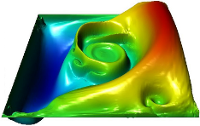
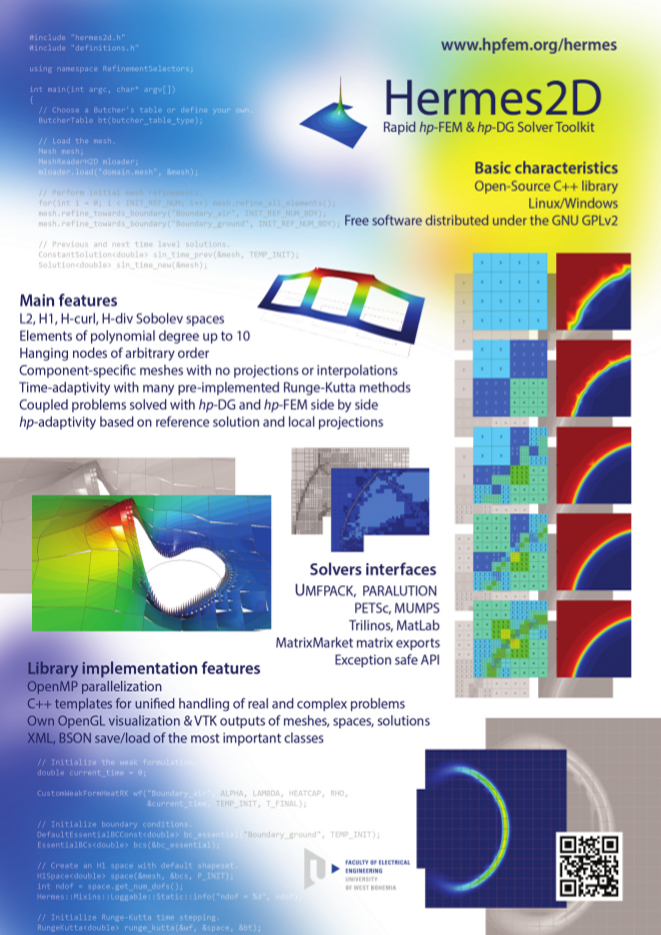
Hermes2D is a C++ library for rapid development of adaptive hp-FEM / hp-DG solvers. Novel hp-adaptivity algorithms are designed to solve a large variety of problems ranging from ODE and stationary linear PDE to complex time-dependent nonlinear multiphysics PDE systems. The code is distributed under the GNU General Public License (Hermes2D and Hermes3D) and BSD License (Hermes1D).
-
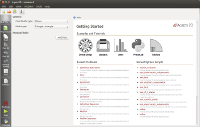
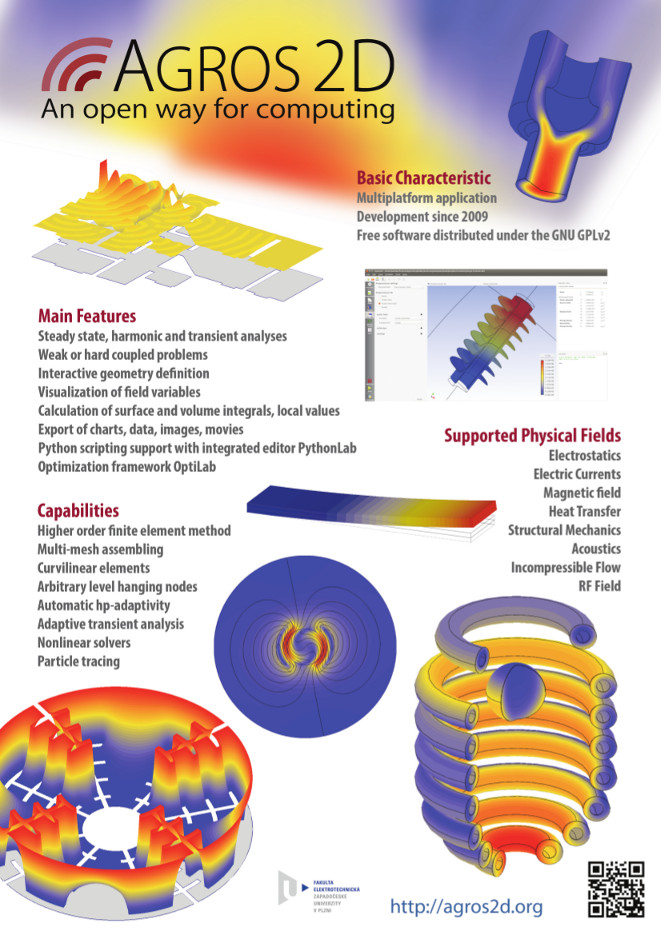
Agros2D is a multiplatform C++ application for the solution of partial differential equations (PDE) based on the Hermes library, developed by the group at the University of West Bohemia in Pilsen. Agros2D is distributed under the GNU General Public License.
-
The aim of Hermes3D is to extend the capabilities of Hermes2D to three spatial dimensions.
In particular, Hermes3D will offer automatic adaptive hp-FEM with arbitrary-level
hanging nodes, monolithic multimesh discretization of multiphysics coupled
problems, and adaptive hp-FEM with dynamically changing meshes for 3D
problems. The development had started and has been temporarily put on hold.
Core Team
International Conferences ESCO and FEMTEC
We organize two series of international conferences: European Seminar on Coupled Problems (ESCO 2012, 2010, 2008) in Europe and Finite Element Methods in Engineering and Science (FEMTEC 2013, 2011, 2009, 2006) in the U.S.
Use Hermes through NCLab
Hermes in its older (serial) version can be used in online tool NCLab thanks to Python wrappers (for the serial version).

NCLab is a third-party product that is not developed by our group at UNR.
The group's How To collection.
Latest News
-
Feburary 2013: New Hermes website, documentation & more
- Visit the site
-
Feburary 2013: Hermes 2.0 released
- Available from the Github repository
-
2013: In 2013, we prepare three international conferences:
- FEMTEC 2013
- AMTEE/CPEE
- ISTET
- August 2012: Presentation of hp-DG, Butcher's tables & adaptive time stepping at Moselle seminar.
- August 2012: Presentation of NCLab at Moselle seminar.
- June 2012: Presentation of Hermes: hp-DG & hp-FEM coupling, Butcher's tables & adaptive time stepping at ESCO 2012.
- June 2012: Presentation of NCLab at ESCO 2012.
- April 2012: Presentation of Hermes: hp-DG & hp-FEM coupling, Butcher's tables & adaptive time stepping at SCA 2012.
- April 2012: Presentation of Hermes modules in NCLab at SCA 2012.
- March 2012: First Hermes2D modules developed.
- January 2012: Hermes2D parallelized.
- November 2011: Abstract Submission for ESCO 2012 Open,
- September 2011: Hermes Version 1.0 Released! Read more here.
- August 2011: The next ESCO 2012 will be organized by FEMhub Inc.
- July 2011: Hermes was presented at invited lectures (Erlangen, Rome, INRIA). Several new people migrated from Comsol to Hermes mostly to use hp-adaptivity with dynamical meshes for transient problems.
- June, 2011: Templating of Hermes2D in progress. The goal is to have only one version of the library (not real and complex versions).
- May 9 -13, 2011: FEMTEC 2011 takes place.
Idaho National Laboratory (INL) grant to explore the potential of adaptive multimesh hp-FEM for nuclear fuel performance analysis.
Major DoE grant for advanced multiphysics computer simulations of nuclear reactor processes in Nevada News.